The Dream of Guilin: Karst Mountains, Rivers, and Ancient Villages
In this article you will find…
A slow journey through Guilin and Yangshuo, where nature becomes poetry and simplicity turns into luxury. You will drift along the Li River, bike through endless rice fields, and meet people whose lives still follow the rhythm of the land. However, this is not merely a travel guide. It is a meditation on beauty — on how the landscape can mirror the soul. Therefore, through this story, you will discover that Guilin’s magic lies not in its famous postcard views, but in the quiet moments between: the mist lifting over the water at dawn, the sound of a bamboo flute echoing in the hills, and the feeling of being part of something timeless.
1. Arrival: First Breath of the South
The moment you arrive in Guilin, you feel a change. The air is thick and warm, carrying the scent of rain and citrus. Mountains rise suddenly from the flat earth, tall and slender, like sleeping giants wrapped in mist. The landscape is so unlike anything else that it seems imagined — as if nature here decided to paint rather than build. The city itself is modest yet graceful, its streets lined with banyan trees and small tea shops. Motorbikes hum softly past, and vendors sell mangoes and steamed buns along the riverbank. The Li River, green as jade, cuts through the city, winding like a slow-moving dragon. Its water reflects the sky so perfectly that you can barely tell where one ends and the other begins. Moreover, Guilin is not loud. Its beauty whispers rather than shouts. Early in the morning, you walk to Elephant Trunk Hill, the city’s most iconic landmark, where the river curves through a natural arch shaped like an elephant drinking. Locals practice tai chi under the trees, their movements fluid and serene. The rhythm of their bodies seems to match the river’s current. In addition, the balance between water and stone feels sacred. The Chinese have a saying: “Guilin’s scenery is the best under heaven.” Standing there, you begin to understand why. Eventually, as you settle into the city’s pace, you notice that time stretches differently here. Everything feels slower, softer, and yet more vivid. You drink your first cup of jasmine tea on a shaded terrace, watching boats glide silently past. The steam rises, mingling with the humid air, and for a moment, you breathe as though the world has exhaled just for you.
2. The Li River: Floating Through a Painted World
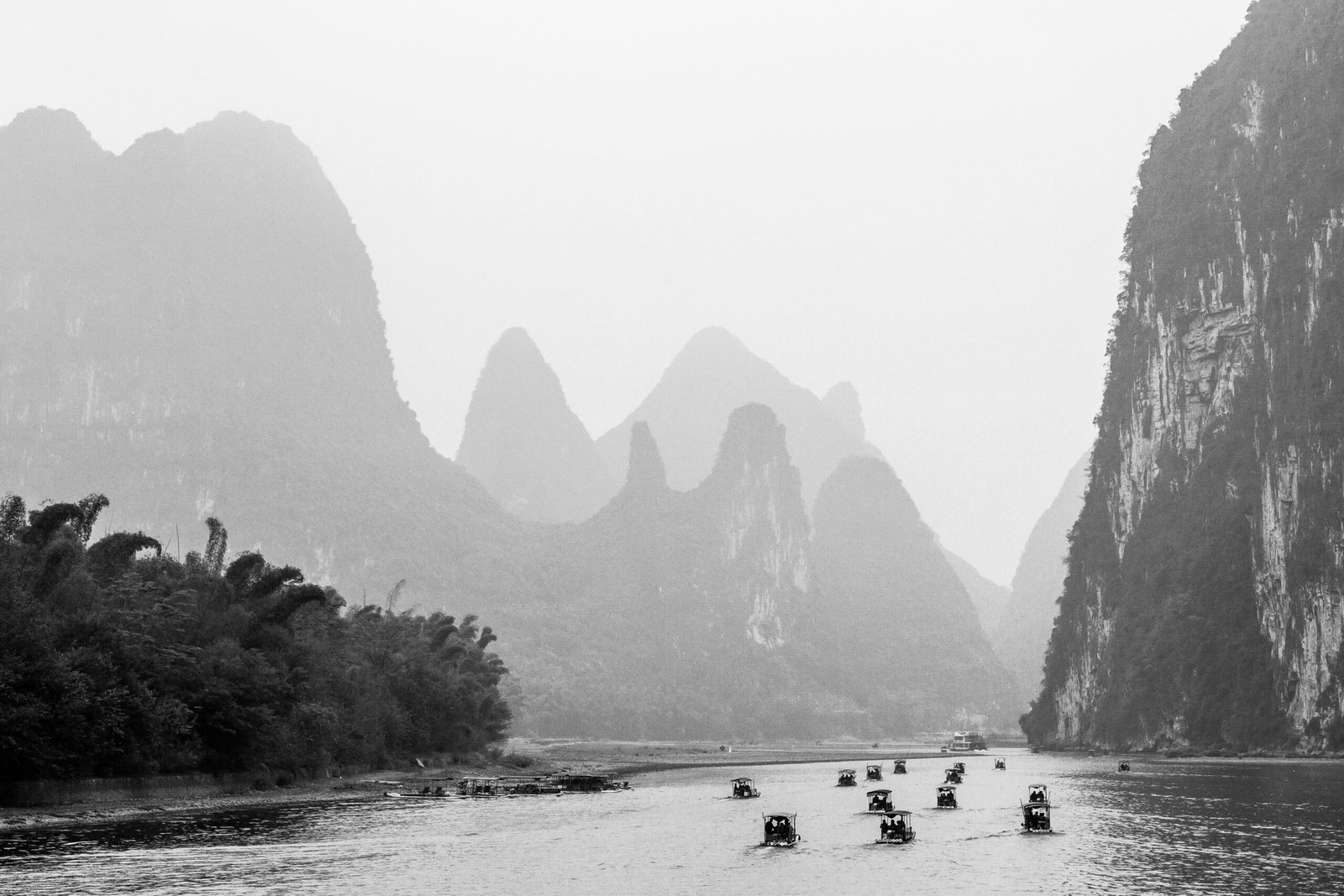
The next morning, you set out on a Li River cruise, the journey that has inspired poets, painters, and travelers for centuries. The boat departs quietly from the pier, and as it moves, the city disappears behind you, replaced by vastness. The river narrows, then widens again, winding through limestone peaks that pierce the clouds. The mist drifts slowly, unveiling shapes that look like dragons, elephants, and towers carved by time. The reflection of the karst mountains in the water creates perfect symmetry, like an ink painting come to life. Moreover, the silence is profound. Occasionally, a fisherman glides past on a bamboo raft, his cormorant perched calmly on the edge. The bird’s silhouette cuts through the fog, its wings spreading in slow motion. The fisherman lifts his hand, a gesture both greeting and blessing. In that instant, you feel as though you have traveled not just through space but through centuries. The Li River is not simply a place; it is an experience of harmony. In addition, every curve of the river offers a new masterpiece. You pass Nine Horses Hill, its surface marked by dark shadows said to resemble nine galloping horses. Locals smile and tell you that spotting all nine brings good fortune. The boat slows, and you try to see them all, your imagination blending with the landscape. Eventually, the river opens up to reveal rice paddies stretching to the horizon. Water buffalo graze quietly in the distance, and small villages appear at the base of the cliffs. Smoke rises from chimneys, curling upward into the mist. The air smells of wet earth and bamboo. Lunch is served on the boat — steamed fish caught fresh that morning, greens sautéed with garlic, and rice sticky and fragrant. You eat slowly, watching the world slide by. There is no rush here, only rhythm. As the cruise ends near Yangshuo, you step onto the pier with the feeling that you have just dreamed with your eyes open.
3. Yangshuo: Between Earth and Sky
Yangshuo welcomes you with a kind of quiet joy. It is smaller than Guilin, wrapped in greenery and framed by peaks that rise so close they seem to touch the rooftops. The town feels like a crossroads between worlds — modern cafés and yoga studios coexist with farmers selling vegetables from bamboo baskets. The contrast is seamless. The air hums with life. In the early morning, you rent a bicycle and follow a narrow path that winds along the Yulong River. The ride is pure freedom. On one side, fields of rice ripple in the breeze; on the other, limestone cliffs cast long shadows on the water. The only sounds are the chirping of cicadas and the soft click of your pedals. Occasionally, a farmer waves as he passes with his ox. Time feels suspended. Moreover, the Yulong River invites stillness. You stop at a small bamboo pier and take a bamboo raft downstream. The raftman poles gently, guiding you through water so clear that you can see fish darting between stones. The current is gentle, the air warm, and the reflections of the mountains shimmer like liquid silk. It is impossible not to feel grateful. In addition, life along the river unfolds slowly. Women wash clothes by the banks; children splash in the shallows; an old man sits carving bamboo pipes while humming an old tune. You realize that what makes this place special is not its beauty alone but its simplicity — the way it invites you to belong. Later, you stop for lunch at a small countryside inn. The food is humble and exquisite: stir-fried greens, braised eggplant, and beer fish, the local specialty cooked with tomatoes, garlic, and local brew. Each bite carries the taste of the land. Eventually, as the afternoon sun turns the mountains golden, you reach a viewpoint above the valley. The landscape spreads below like a tapestry of green and silver. You sit there, silent, knowing that this is one of those rare places where peace does not need to be searched for — it simply exists.
4. The Spirit of the Villages
Beyond Yangshuo’s town center, the countryside holds secrets worth finding. Small villages like Fuli, Xingping, and Jiuxian preserve a China that feels untouched by time. You wander through narrow stone lanes where the walls are marked by centuries of rain and stories. Doors are painted red, symbols of luck fading into wood. The air smells faintly of woodsmoke and jasmine. In Fuli, known for its traditional fan painting, you meet an elderly artist named Chen. His workshop is small and filled with the scent of ink. Brushes, paper, and bamboo fans lie scattered on a table. He paints slowly, each stroke deliberate. When you ask how long he has been painting, he smiles and says, “Since before I learned to write.” His eyes hold the stillness of mountains. Moreover, art here is not performance but rhythm. The people of Guilin do not separate beauty from daily life. It lives in gestures — in the way rice is planted, in the way tea is poured, in the care with which fans are painted. In addition, the hospitality is quiet but profound. You are invited into homes for tea, for conversation, for nothing more than presence. Cups are refilled before they empty, and questions about where you are from turn naturally into stories about ancestors, floods, and festivals. There is no hurry. Eventually, as you leave one of these homes, you glance back and see the family standing in the doorway, waving as if you were an old friend. The simplicity of the moment stays with you. The villages of Guilin remind you that beauty, when lived, becomes invisible — it is just life, and that is enough.
5. Nature’s Silence: Caves, Hills, and Reflections
Beyond the rivers and fields, Guilin’s landscape hides wonders underground and above. The Reed Flute Cave, just outside the city, is one of them. Inside, stalactites and stalagmites rise like frozen music, illuminated by soft lights that paint the rock in hues of blue, green, and amber. The air is cool and damp, carrying the scent of stone and time. You walk slowly, the echo of your footsteps blending with dripping water. The formations seem alive — delicate, otherworldly, eternal. Moreover, outside the cave, the hills themselves seem to breathe. The Diecai Hill, known as Folded Brocade Hill, offers one of the best views in Guilin. The climb is steep but rewarding. From the top, the city lies below like a watercolor — rivers weaving through green peaks, clouds drifting lazily across the sky. The air smells of rain and grass, and you feel weightless. In addition, the balance of elements — earth, water, air, and light — feels perfect here. It is as if the land itself practices meditation. Later, you visit the Seven Star Park, where ancient banyan trees twist their roots into the earth and monkeys leap playfully through the branches. A small pagoda stands quietly at the center, its reflection trembling in a pond. You sit beside it for a long time, letting the silence sink in. The noise of the world fades, and only the rustle of leaves remains. Eventually, you realize that Guilin’s magic does not depend on where you go but on how you see. Every hill, every river, every shadow of mist invites you to slow down, to listen, and to remember that beauty, when witnessed with attention, becomes prayer.
6. Nightfall in Yangshuo: Reflections of Light and Soul
When evening descends on Yangshuo, the air turns soft and golden. The streets fill with the scent of grilled skewers and sweet rice cakes. Lanterns light up one by one, their red glow reflecting in the river. Musicians play bamboo flutes by the water, their notes floating into the night. The town feels alive but gentle, festive but intimate. You walk along West Street, where travelers and locals mingle easily. The shops sell handmade crafts, tea sets, and calligraphy brushes. You stop for a drink at a riverside bar, the lights shimmering on the surface of the Yulong River. The sound of laughter blends with the murmur of the water. Moreover, the night sky here is different — closer somehow, deeper. Stars appear slowly, scattered across the darkness like grains of rice. You look up, tracing constellations you cannot name. In addition, the reflection of the lanterns in the water seems to mirror the stars above. The boundary between earth and sky dissolves. A soft wind rises, carrying the scent of orange blossoms. Eventually, you realize that this is the rhythm of Guilin: it does not ask for attention; it gives it. It teaches you that peace is not absence but balance — between light and dark, sound and silence, presence and longing. When you finally return to your guesthouse, you slide open the wooden window and listen to the river outside. Somewhere, a flute plays a few lingering notes, fading slowly into quiet. You smile, knowing that this sound, like Guilin itself, will stay with you long after you leave.