
The Spirit of Mount Fuji: Harmony Between Earth and Sky
In this article you will find…
A journey around Mount Fuji, the mountain that has watched Japan breathe for millennia. You will travel through misty lakes, sacred shrines, steaming onsen, and trails that lead into the clouds. You will meet the quiet devotion of pilgrims, the laughter of travelers soaking in hot springs, and the reflection of Fuji mirrored perfectly in still waters. However, this story is not only about geography. It is about balance — between strength and gentleness, between movement and peace. Therefore, through this journey, you will discover that Fuji is not just a mountain; it is a mirror of the human spirit, a place where the visible and the invisible meet.
1. The First Sight: Meeting a Sacred Mountain
There are few moments in life that feel entirely pure, and the first time you see Mount Fuji is one of them. The train from Tokyo speeds through suburbs and rice fields until, suddenly, there it is — perfectly symmetrical, rising out of the earth like a dream made solid. The peak, often dusted with snow even in spring, glows pink under the early light. The passengers fall silent, as if on cue. The mountain commands reverence without asking for it. Moreover, Fuji is not just a natural wonder; it is a presence. Artists have painted it, poets have praised it, and pilgrims have climbed it for over a thousand years. It is woven into Japan’s identity like a thread of divinity. When you arrive in Kawaguchiko, one of the five lakes surrounding the mountain, the air feels different — thinner, cleaner, almost musical. The lake mirrors Fuji so perfectly that it’s hard to know which side is real. You rent a bicycle and follow a narrow road along the water, passing cherry trees in bloom and wooden houses that smell faintly of cedar. Each turn reveals a new angle of the mountain, each reflection a new emotion. In addition, the locals treat Fuji with affection, not awe. They greet it every morning as if it were an old friend, bowing slightly when the clouds lift. You understand that this is not superstition but gratitude. Eventually, you stop by the shore and simply watch. The water ripples gently, birds circle above, and the mountain stands still, as if breathing with you. The moment feels endless, and you realize that Fuji’s power is not in its size but in its silence.
2. The Fuji Five Lakes: Mirrors of the Sky
Surrounding Mount Fuji are five lakes, each offering a different reflection of its beauty. You begin with Lake Kawaguchi, the most accessible and perhaps the most photogenic. Early morning is the best time to visit, when the water is calm and the light soft as silk. The mountain rises behind the town, its reflection sharp and silver in the surface of the lake. Boats drift quietly, leaving ripples that vanish like breath. Moreover, Kawaguchi is not only about views. Small art museums, cafés, and ryokan inns line its shore, each one offering a new way to experience calm. You stop at a small teahouse with paper windows overlooking the water. The owner, an elderly woman, serves you matcha and a delicate sweet shaped like a plum blossom. She tells you that her family has lived there for generations, always watching Fuji change with the seasons — pink with cherry blossoms, green with summer, red with autumn, white with snow. In addition, you visit Lake Yamanaka, the highest of the five. The air here feels colder, crisper, and the wind carries the scent of pine. Swans glide along the surface, their feathers glowing in the sunlight. The locals call it “the lake that sings,” because the wind over the water creates a sound that feels almost human. Further west lies Lake Saiko, surrounded by dense forests. The road curves through bamboo groves and cedar trees, leading to hidden campsites and trails. The mountain is often veiled in clouds here, its presence felt more than seen. Eventually, you reach Lake Motosu, the one depicted on Japan’s 1,000-yen bill. Its water is deep and clear, colored like sapphire. Standing there, you understand why artists and poets have called Fuji “the mirror of the soul.” Every reflection is a conversation between heaven and earth, between what is real and what is dreamed.
3. Hakone: Hot Springs and Floating Torii
To the east of Fuji lies Hakone, a region famous for its hot springs and views that make you forget the world. The journey there feels like a meditation — trains and cable cars weaving through misty forests, the air heavy with the scent of sulfur and rain. When you arrive at Lake Ashi, the sight takes your breath away. The water is calm, and the torii gate of Hakone Shrine rises from its surface, bright red against the silver lake. The reflection shimmers softly, and behind it, Mount Fuji appears through the clouds, distant yet perfect. Moreover, Hakone is a place where comfort meets reverence. You check into a ryokan, a traditional Japanese inn, where everything seems designed to restore balance. Tatami mats line the floor, sliding screens open onto a garden, and a private onsen bath steams beside a wooden deck. The water, rich with minerals, feels like silk against your skin. You soak quietly as rain taps the surface, the steam rising toward the forest. In that moment, you understand the Japanese word shinrinyoku — forest bathing, the act of letting nature heal you. In addition, you visit the Hakone Open-Air Museum, where sculptures stand among trees and mist. Art and nature blend seamlessly. A giant Picasso mosaic overlooks a valley filled with autumn colors. A spiral tower invites you to climb and look out over the land. Everything feels both human and divine. Eventually, as the day ends, you return to the lake. The torii glows softly under lantern light, and the sound of water fills the air. You bow slightly, not to a god, but to the peace that lives in this place.
4. The Pilgrim Path: Climbing Toward the Sky
Although most travelers admire Fuji from below, many still choose to climb it, at least once in their lives. The official climbing season runs from July to early September, when the snow melts and the paths are clear. You decide to make the ascent partway, not for conquest but for communion. The Yoshida Trail, starting near Kawaguchiko, winds gently upward through forests of cedar and bamboo. The air is thin, and the sound of footsteps on volcanic rock echoes softly. Along the way, small shrines mark the stations, their bells ringing faintly in the wind. Pilgrims have walked this same path for centuries, chanting prayers as they climbed. Moreover, each step feels symbolic — an act of letting go. You pass a group of monks in saffron robes, their faces calm, their pace steady. One of them nods as you meet his eyes, a silent blessing. The higher you go, the more the world below fades. The cities, the noise, the urgency of life all dissolve into mist. In addition, as the air grows colder, you stop to rest near the fifth station. The view is overwhelming: clouds stretch beneath you like oceans, and the horizon burns gold with sunset. The mountain’s shadow falls across the land like a hand closing in prayer. You sit quietly, breathing deeply, feeling both small and infinite. Eventually, as night falls, stars appear above you, bright and close. The summit feels near, yet you know it does not matter if you reach it. The lesson is already clear — Fuji does not ask to be conquered but understood.
5. Shrines and Spirits: The Sacred Heart of Fuji
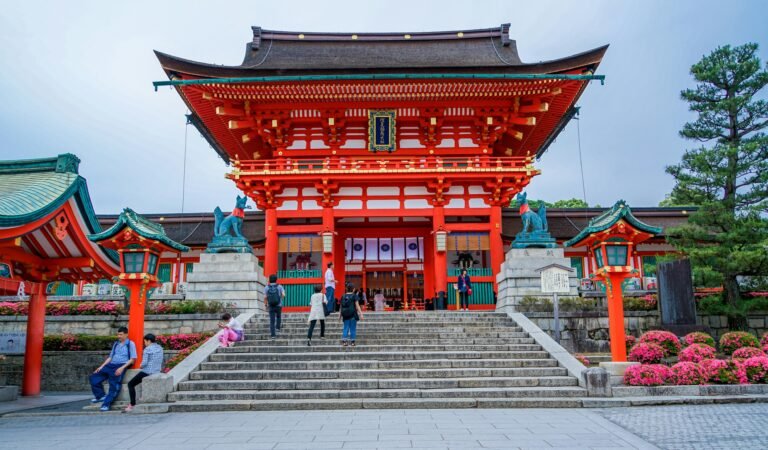
At the base of the mountain lies Fujiyoshida Sengen Shrine, one of the most important in Japan. Built over a thousand years ago, it marks the traditional starting point for pilgrimages to Fuji’s summit. The torii gate at its entrance is enormous, painted in vermilion that glows softly under the morning sun. A long stone path leads through an ancient forest of cedar trees, their trunks wide and moss-covered. The air feels thick with history. The only sounds are the rustling of leaves and the faint ringing of bells from the main hall. Moreover, the shrine is dedicated to Konohanasakuya-hime, the goddess of Mount Fuji, often called “the blossom princess.” Her story symbolizes both fragility and strength — beauty that endures even through fire. You offer a coin, bow twice, clap twice, and bow once again. The ritual feels simple, yet it carries a weight beyond words. In addition, nearby stands Oshino Hakkai, a small village built around eight crystal-clear ponds fed by Fuji’s melting snow. The water is so transparent that it seems unreal. Carp glide through it like strokes of color on glass. Villagers sell mochi, grilled corn, and matcha ice cream to visitors who wander between wooden bridges. The atmosphere feels timeless. You buy a small wooden charm inscribed with the character for peace and tie it to a tree beside the pond. The wind moves through the leaves, and you imagine your wish carried upward toward the mountain. Eventually, you walk back along the forest path. The light filters through the trees like gold dust, and for a moment, you feel Fuji’s presence again — not distant, not towering, but near and gentle, like a breath.
6. The Reflection: Lessons from the Mountain
On your final morning, the sky is perfectly clear. You wake early and walk to the edge of Lake Kawaguchi before sunrise. The air is cold, the world still half-asleep. As the first light appears, Fuji glows in shades of pink and silver, its reflection forming a perfect circle of symmetry on the water. The scene is so quiet that even the smallest sound — the ripple of a fish, the flap of a bird’s wings — feels sacred. You sip coffee from a small thermos, the warmth spreading through your hands, and think about everything this journey has shown you. Moreover, you realize that Fuji is not just a mountain of stone and snow. It is a teacher. It teaches patience through its stillness, humility through its scale, and gratitude through its beauty. It reminds you that strength does not need to shout, and that balance is not a goal but a way of being. In addition, you notice how the light keeps changing — one minute golden, the next silver, the next almost blue. The mountain never stays the same, yet it never loses its shape. It is a living metaphor for life itself. Eventually, as the sun rises fully, the reflection fades, replaced by the shimmer of daylight. You close your eyes and breathe deeply. The air smells of pine, water, and snow. Somewhere in the distance, a bell rings from a shrine, its tone soft and pure. You open your eyes one last time, and Fuji stands there, calm and eternal. You bow slightly before turning away, carrying its silence with you — a silence that feels full, not empty, alive with meaning and light.